In this work, we address the limitation of surface fitting-based grasp planning algorithm, which primarily focuses on geometric alignment between the gripper and object surface while overlooking the stability of contact point distribution, often resulting in unstable grasps due to inadequate contact configurations. To overcome this limitation, we propose a novel surface fitting algorithm that integrates contact stability while preserving geometric compatibility. Inspired by human grasping behavior, our method disentangles the grasp pose optimization into three sequential steps: (1) rotation optimization to align contact normals, (2) translation refinement to improve the alignment between the gripper frame origin and the object Center of Mass (CoM), and (3) gripper aperture adjustment to optimize contact point distribution. We validate our approach in simulation across 15 objects under both Known-shape (with clean CAD-derived dataset) and Observed-shape (with YCB object dataset) settings, including cross-platform grasp execution on three robot—gripper platforms. We further validate the method in real-world grasp experiments on a UR3e robot. Overall, DISF reduces CoM misalignment while maintaining geometric compatibility, translating into higher grasp success in both simulation and real-world execution compared to baselines.
Overview
While surface fitting algorithms based on geometric compatibility optimization offer high flexibility, they do not sufficiently account for whether the aligned surfaces actually lead to a stable grasp.
Specifically, achieving a stable grasp requires the ability to generate contact forces that can fully counteract external forces and torques (known as force-closure property).
However, by focusing solely on geometric alignment, these methods fail to consider fundamental factors necessary for generating contact forces, such as the appropriate spatial relationship between the hand and the object.
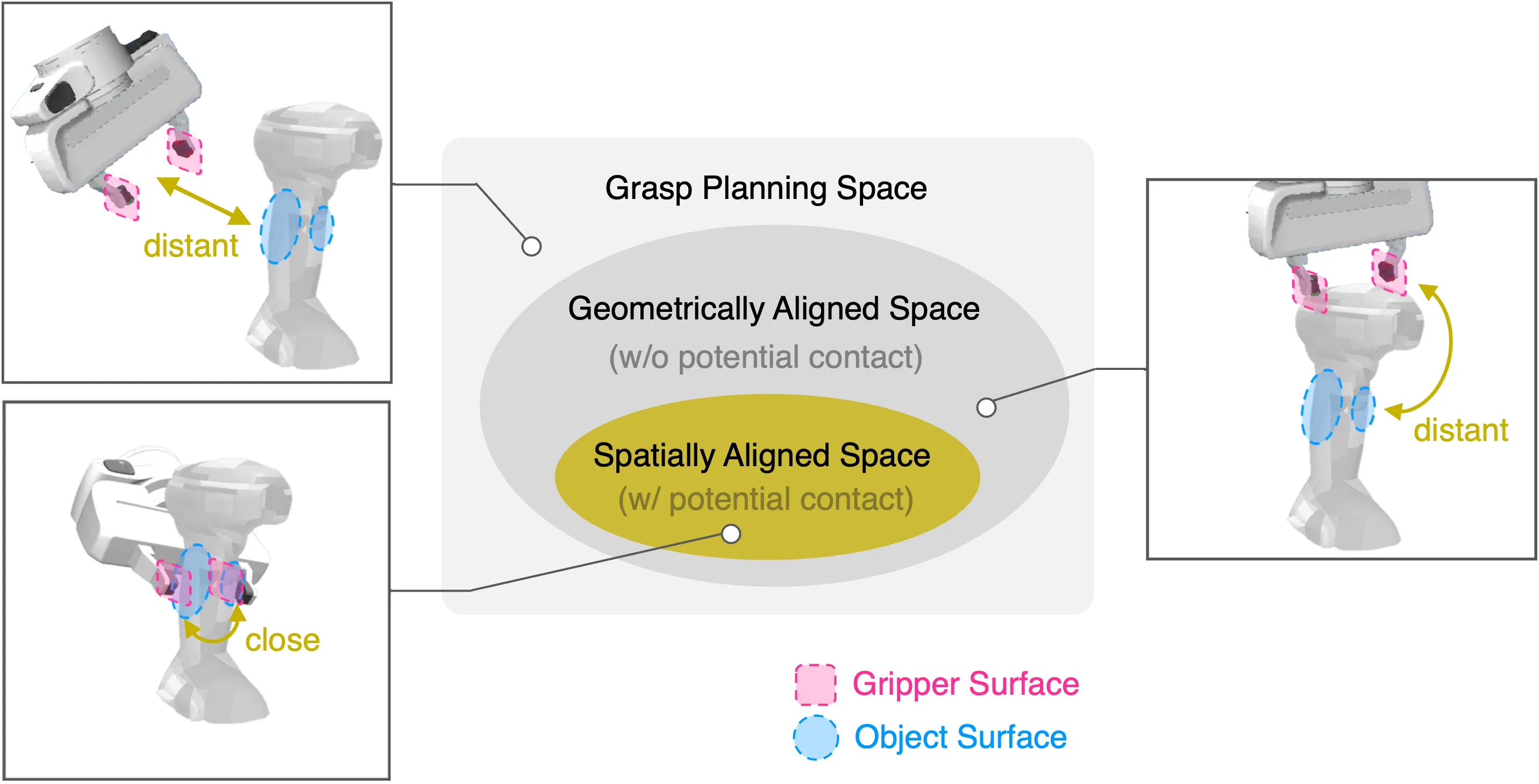
As a result, even if the surfaces are geometrically well-aligned, a spatial gap can form between the hand and the object, preventing actual contact from being established, or leading to an unstable distribution of contact points.
To address this issue, it is essential not only to align surfaces based on geometric compatibility but also to ensure that the hand and object surfaces are spatially well-aligned, allowing contact to be potentially established.
We refer to this spatial alignment, which facilitates contact, as contact stability (Fig.1).
Figure 1: The relationship between the grasp planning space, geometrically aligned space, and spatially aligned space.
Proposed Framwork
In this study, we propose a novel surface fitting-based grasp planning algorithm that incorporates contact stability alongside geometric compatibility, which we call Disentangled Iterative Surface Fitting (DISF).
From the perspective of contact stability, we explicitly integrate CoM alignment into the optimization process, drawing inspiration from the observation that, as mentioned earlier, humans naturally align their hand’s CoM with that of the object to enhance grasp stability.
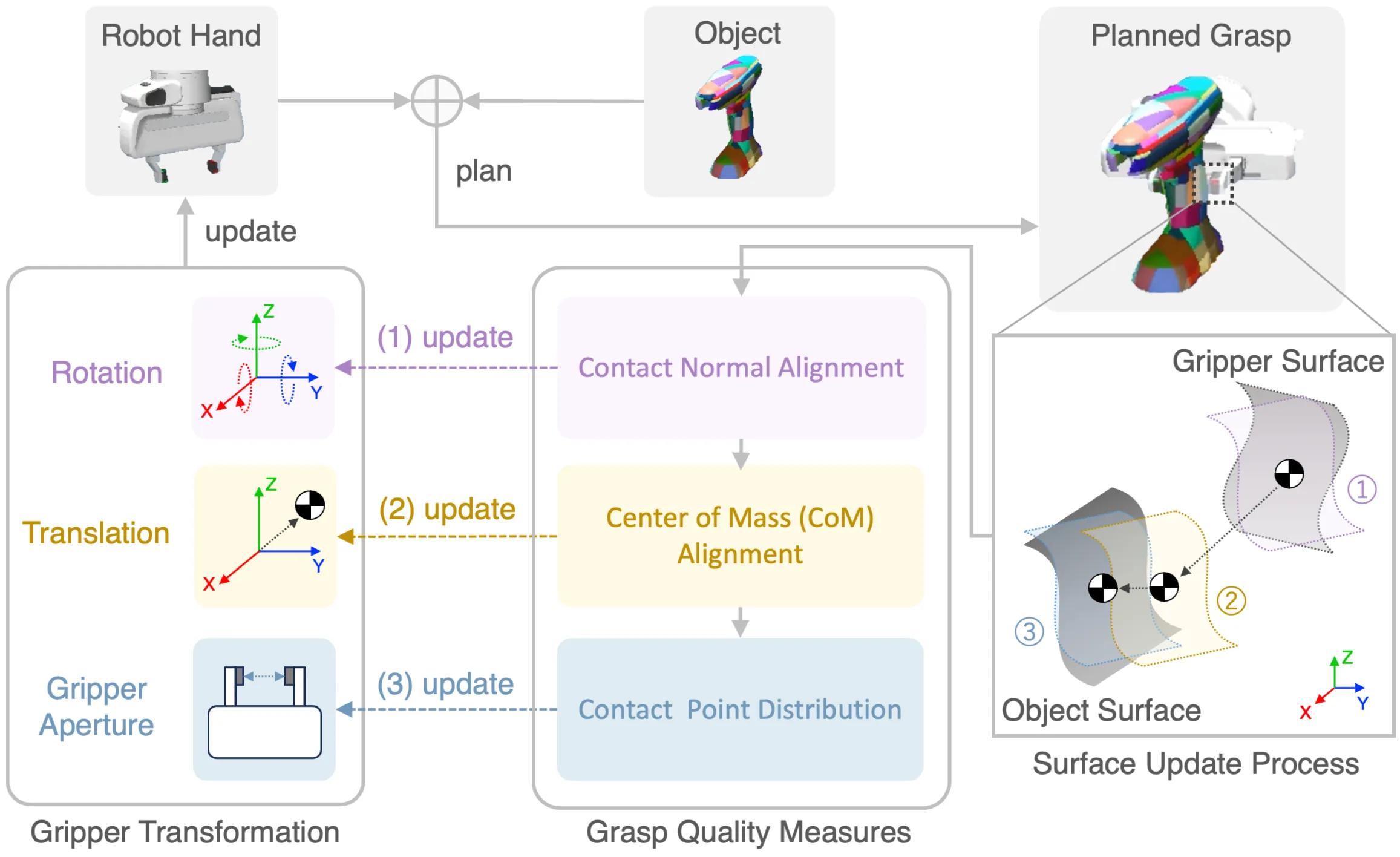
To achieve this, we leverage another key insight from human grasping behavior-that different pose parameters are optimized sequentially rather than simultaneously-and disentangle the overall grasp pose optimization into the following three sequential stages:
(1) rotation optimization to align contact normals,
(2) translation refinement for CoM alignment, and
(3) gripper aperture adjustment to optimize contact point distribution.
Our disentangled optimization framework preserves the advantages of flexible geometric compatibility evaluation while systematically enhancing contact stability through CoM alignment. The overview of our DISF framework is shown in Fig.2.
Figure 2: Overview of the proposed DISF framework.
Contact Surface Optimization
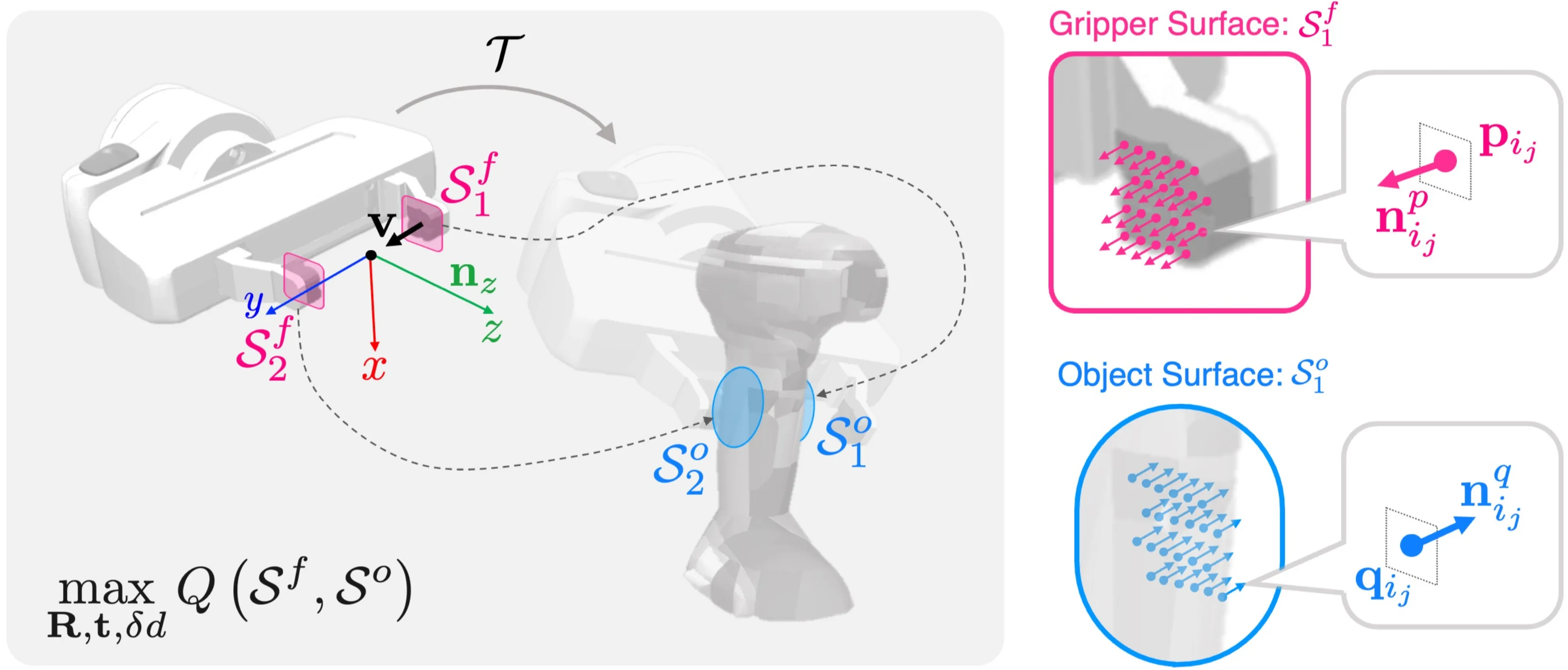
The grasp planning problem with antipodal grippers can be modeled as a contact surface optimization problem
which maximizes the grasp quality Q by optimizing the rotation and translation parameter (R,t)
as well as the fingertip displacement δd from the original gripper width,
given a specific set of contact surfaces between the fingertip Sf
and object So.
This optimization can be demonstrated in Fig.3.
Figure 3: An image demonstrating how grasp planning can be reformulated as a contact surface optimization problem.
Simulation Experiment
Grasp Quality Evaluation
Figure 4: The results of planned grasp quality.
Grasp Success Rate Evaluation
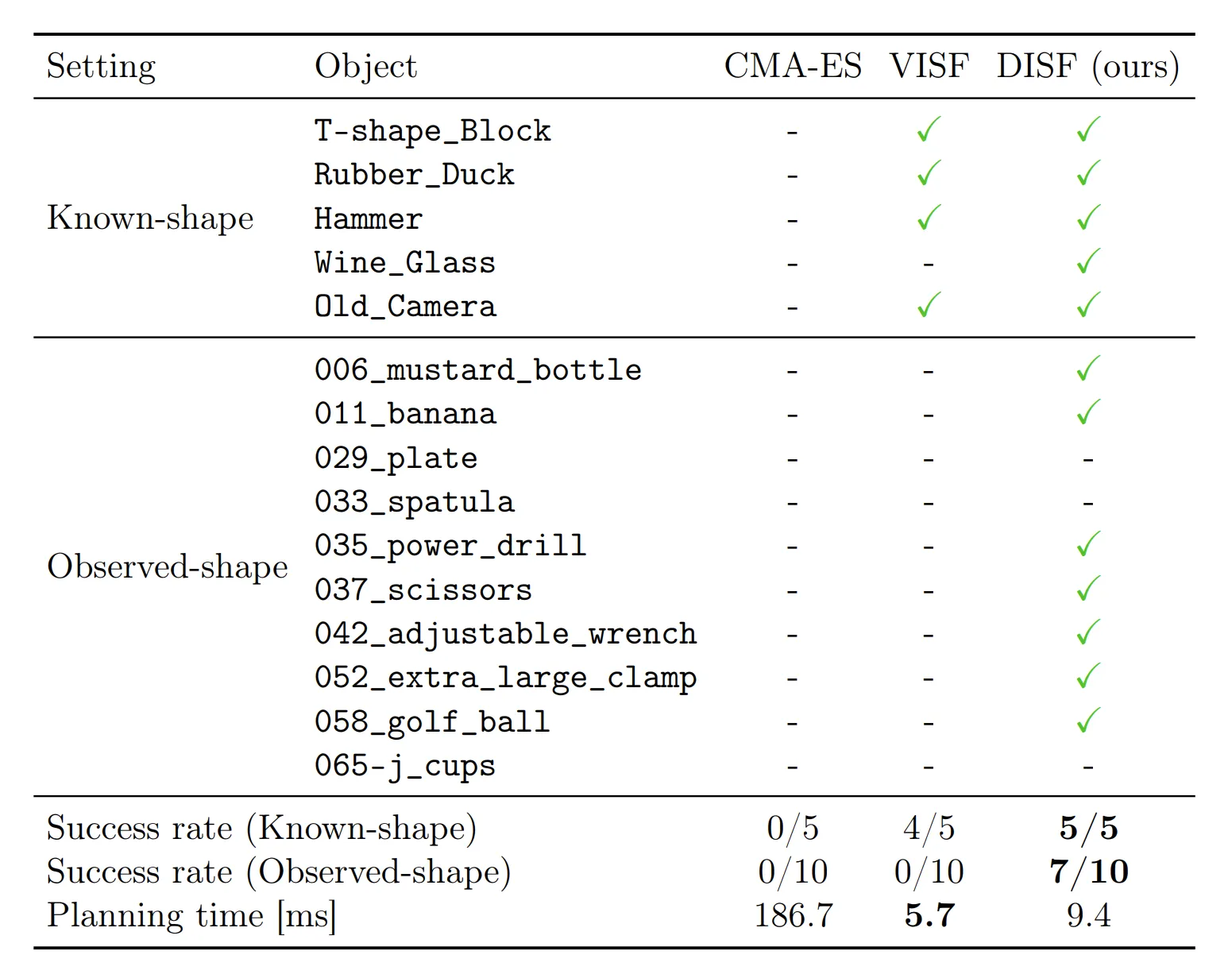
Table 1: Grasp success on the Panda robot for the Known-shape and
Observed-shape regimes. The Known-shape regime uses 3D CAD objects,
while the Observed-shape regime uses YCB objects.
The checkmark (✅ ) indicates success, while the horizontal bar (-) indicates failure.
The bottom row reports the overall grasp success rate for each method across all objects of each setting and its average planning time.
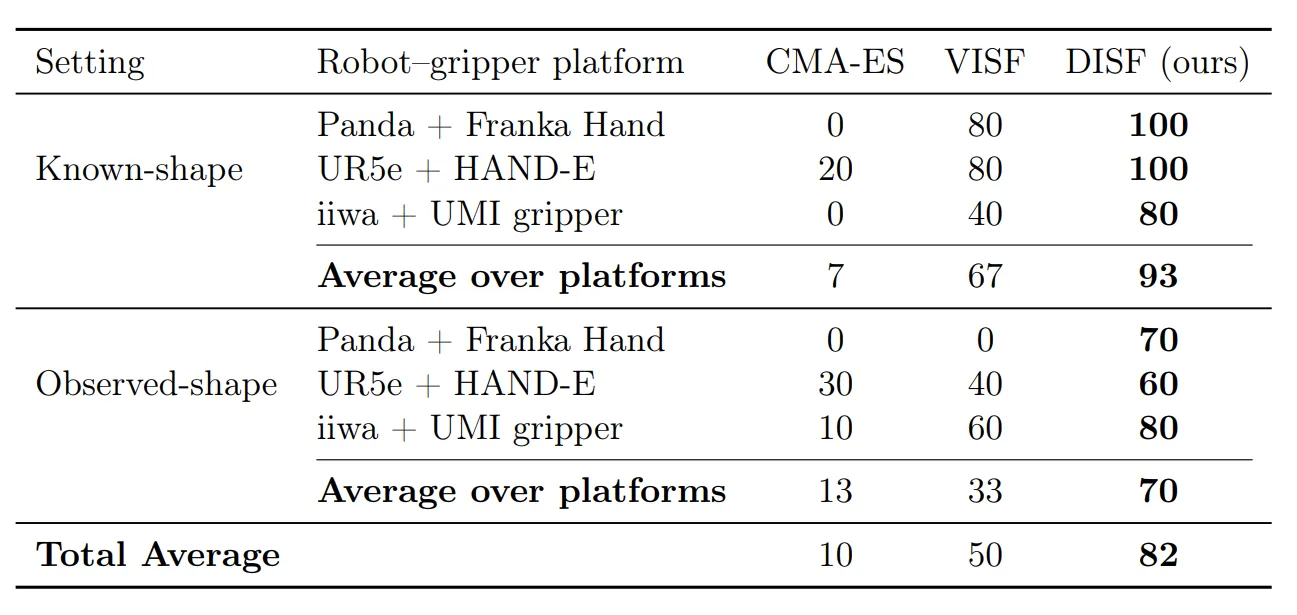
Table 2: Average grasp success rate (\%) across robots and evaluation regimes.
Each robot row is averaged over all objects in the corresponding
setting.
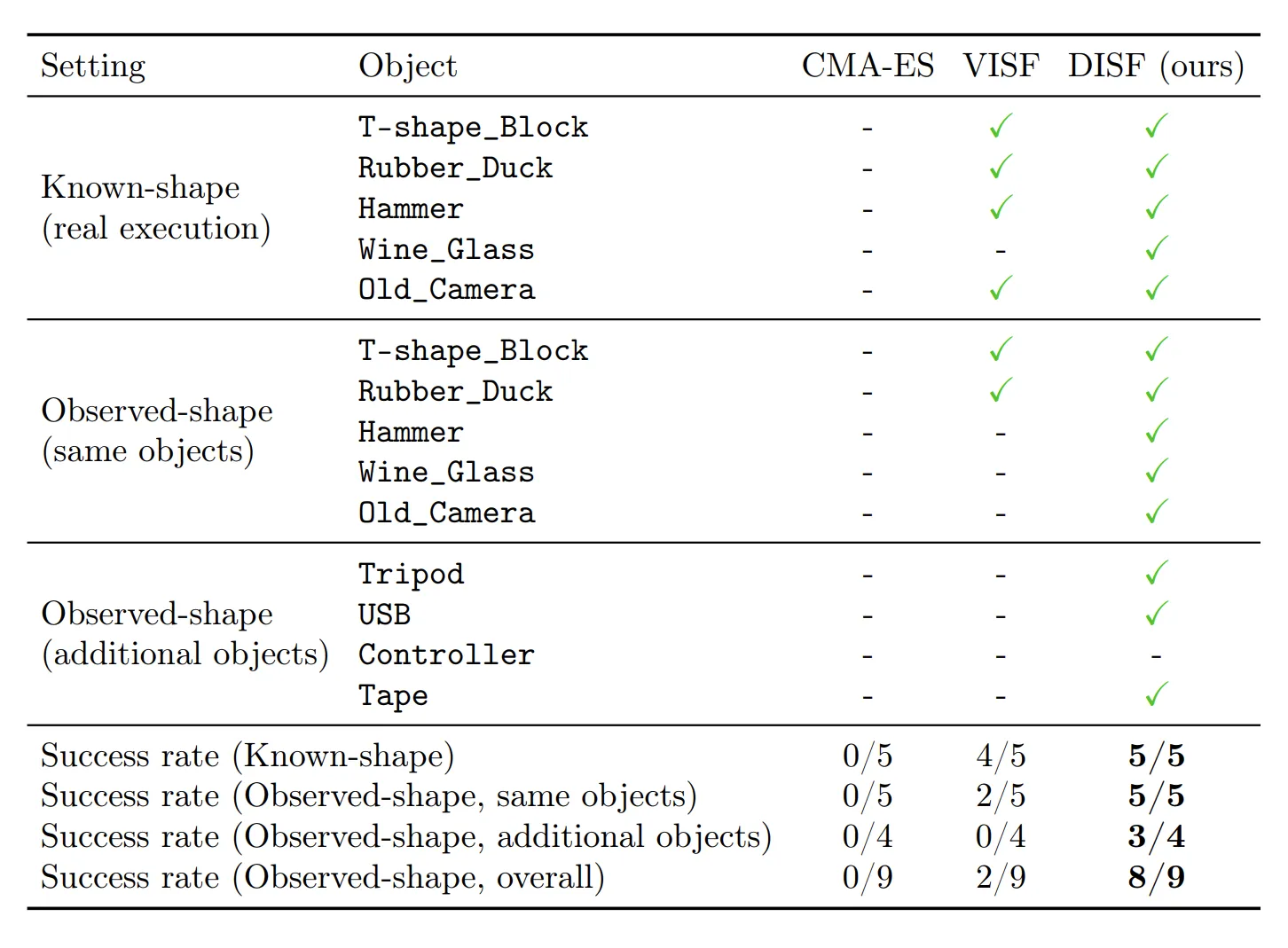
Table 3 shows real-world grasp success results under the Known-shape and Observed-shape settings.
The performance gap between DISF and VISF widens markedly under observed geometry.
On the same objects as in the Known-shape evaluation, DISF achieves an identical success rate to the Known-shape setting, while VISF degrades.
CMA-ES again fails across all Observed-shape trials.
DISF further generalizes to additional everyday objects introduced only in the Observed-shape setting, demonstrating robustness to partial and noisy geometric observations.
Table 3: shows real-world grasp success results under the Known-shape and Observed-shape settings.
The Observed-shape setting is reported in two blocks: (i) the same objects as the Known-shape setting (enabling a direct Known vs. Observed comparison), and (ii) additional objects used only in the Observed-shape setting.
The checkmark (✅) indicates success, while the horizontal bar (-) indicates failure.
BibTeX citation
@inproceedings{disf_arXiv_2025, author = {Tomoya Yamanokuchi, Alberto Bacchin, Emilio Olivastri, Ryotaro Arifuku, Takamitsu Matsubara, Emanuele Menegatti}, title = {DISF: Disentangled Iterative Surface Fitting for Contact-stable Grasp Planning with Grasp Pose Alignment to the Object Center of Mass}, booktitle = {arXiv Preprint}, year = {2025},}