Tomoya Uho (formerly Yamanokuchi)
Specially Appointed Assistant Professor, Robot Learning Lab, Nara Institute of Science and Technology (NAIST), Japan
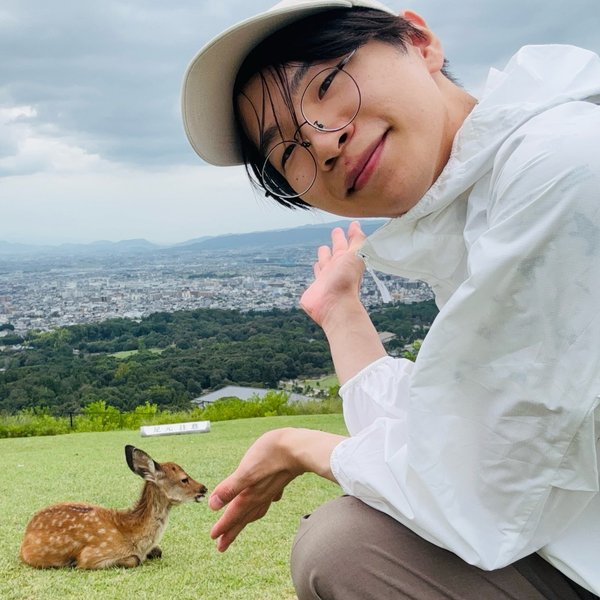
Tomoya Uho (formerly Yamanokuchi) is a Specially Appointed Assistant Professor in the Robot Learning Lab at the Nara Institute of Science and Technology (NAIST). His research is on learning-based robotic manipulation, with a focus on transferring what a robot learns in simulation to the real world. He works on representation learning and probabilistic models that separate task-relevant structure from visual variation, and on applying them to visual model predictive control and contact-stable grasp planning.
He received his Ph.D. from NAIST in 2024 with a thesis on disentangled dynamics learning for sim-to-real robotic manipulation, and spent two research stays at the IAS-Lab, University of Padua, Italy. More about his training and career is on the CV page.
Research Interests
- Bayesian probabilistic inference
- Representation learning
- Sim-to-real transfer
- Visual model predictive control
- Grasp planning
News
| Dec 2025 | Preprint posted to arXiv: “DISF: Disentangled Iterative Surface Fitting for Contact-stable Grasp Planning with Grasp Pose Alignment to the Object Center of Mass”. [arXiv] [Project Page] |
|---|---|
| Sep 2025 | Our work on visited-state augmentation for contrastive reinforcement learning was presented at the 43rd Annual Conference of the Robotics Society of Japan (RSJ 2025), Tokyo. |
| 2025 | Our paper “Disentangled Iterative Surface Fitting for Contact-stable Grasp Planning” was selected as a Best Paper Award Finalist at IAS-19. [Project Page] |
| Sep 2024 | Started a stay as a Visiting Scholar at the Intelligent Autonomous Systems Laboratory (IAS-Lab), University of Padua, Italy (until December 2024). |
Selected Publications
-
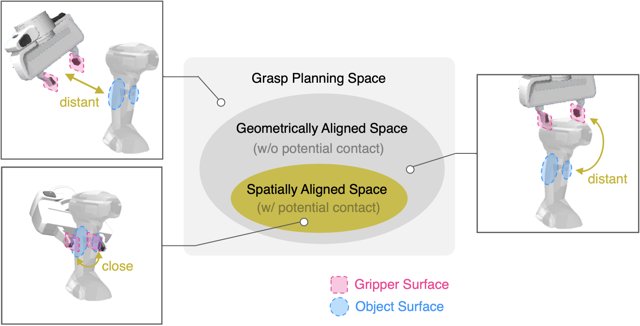 RAS 2026DISF: Disentangled Iterative Surface Fitting for Contact-stable Grasp Planning with Grasp Pose Alignment to the Object Center of Mass
In this work, we address the limitation of surface fitting-based grasp planning algorithm, which primarily focuses on geometric alignment between the gripper and object surface while overlooking the stability of contact point distribution, often resulting in unstable grasps due to inadequate contact configurations. To overcome this limitation, we propose a novel surface fitting algorithm that integrates contact stability while preserving geometric compatibility. Inspired by human grasping behavior, our method disentangles the grasp pose optimization into three sequential steps: (1) rotation optimization to align contact normals, (2) translation refinement to improve the alignment between the gripper frame origin and the object Center of Mass (CoM), and (3) gripper aperture adjustment to optimize contact point distribution. We validate our approach in simulation across 15 objects under both Known-shape (with clean CAD-derived dataset) and Observed-shape (with YCB object dataset) settings, including cross-platform grasp execution on three robot–gripper platforms. We further validate the method in real-world grasp experiments on a UR3e robot. Overall, DISF reduces CoM misalignment while maintaining geometric compatibility, translating into higher grasp success in both simulation and real-world execution compared to baselines.
@article{yamanokuchi2026disf_ras, author = {Yamanokuchi, Tomoya and Bacchin, Alberto and Olivastri, Emilio and Arifuku, Ryotaro and Matsubara, Takamitsu and Menegatti, Emanuele}, title = {DISF: Disentangled Iterative Surface Fitting for Contact-stable Grasp Planning with Grasp Pose Alignment to the Object Center of Mass}, journal = {Robotics and Autonomous Systems}, year = {2026}, url = {https://www.sciencedirect.com/science/article/abs/pii/S0921889026004082}, } -
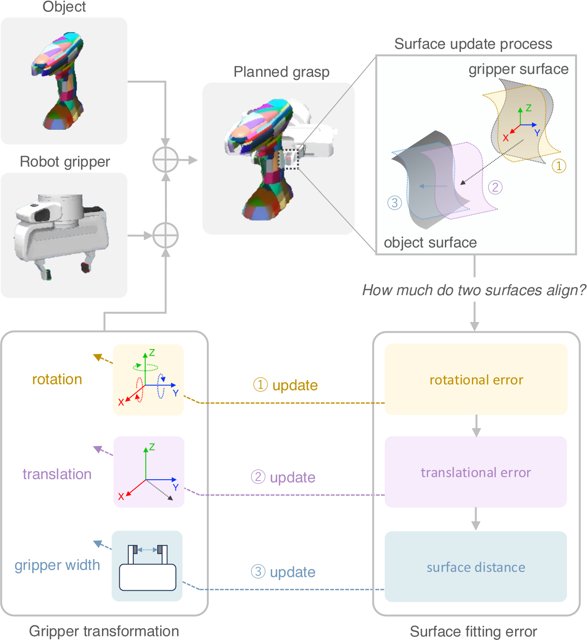 IAS-19 2025Disentangled Iterative Surface Fitting for Contact-stable Grasp Planning
In this work, we address the limitation of surface fitting-based grasp planning algorithm, which primarily focuses on geometric alignment between the gripper and object surface while overlooking the stability of contact point distribution, often resulting in unstable grasps due to inadequate contact configurations. To overcome this limitation, we propose a novel surface fitting algorithm that integrates contact stability while preserving geometric compatibility. Inspired by human grasping behavior, our method disentangles the grasp pose optimization into three sequential steps: (1) rotation optimization to align contact normals, (2) translation refinement to improve Center of Mass (CoM) alignment, and (3) gripper aperture adjustment to optimize contact point distribution. We validate our approach through simulations on ten YCB dataset objects, demonstrating an 80% improvement in grasp success over conventional surface fitting methods that disregard contact stability.
@inproceedings{yamanokuchi2025disf, author = {Yamanokuchi, Tomoya and Bacchin, Alberto and Olivastri, Emilio and Matsubara, Takamitsu and Menegatti, Emanuele}, title = {Disentangled Iterative Surface Fitting for Contact-stable Grasp Planning}, booktitle = {International Conference on Intelligent Autonomous Systems (IAS-19)}, year = {2025}, eprint = {2502.11535}, archivePrefix = {arXiv}, } -
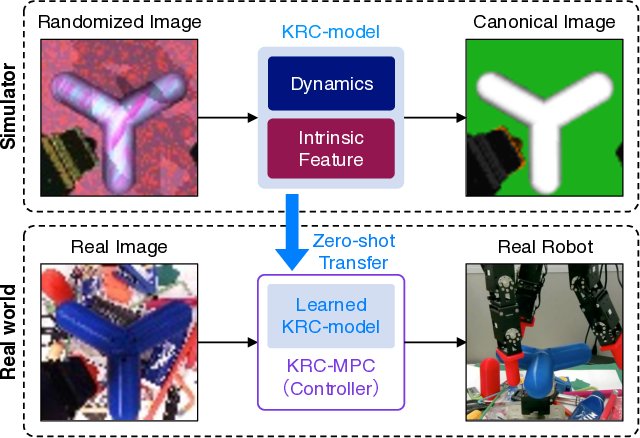 RA-L 2022Randomized-to-Canonical Model Predictive Control for Real-world Visual Robotic Manipulation
Many works have recently explored Sim-to-real transferable visual model predictive control (MPC). However, such works are limited to one-shot transfer, where real-world data must be collected once to perform the sim-to-real transfer, which remains a significant human effort of transferring the models learned in simulations to new domains in the real world. To alleviate these problems, we first propose a novel model-learning framework called Kalman Randomized-to-Canonical Model (KRC-model). This framework is capable of extracting task-relevant intrinsic features and their dynamics from randomized images. We then propose Kalman Randomized-to-Canonical Model Predictive Control (KRC-MPC) as a zero-shot sim-to-real transferable visual MPC using KRC-model. The effectiveness of our method is evaluated through valve rotation tasks by a robot hand in both simulation and the real world, and the block mating tasks in simulation. The experimental results show that KRC-MPC can be applied to various real domains and tasks in a zero-shot manner.
@article{yamanokuchi2022rcmpc,
  author  = {Yamanokuchi, Tomoya and Kwon, Yuhwan and Tsurumine, Yoshihisa and Uchibe, Eiji and Morimoto, Jun and Matsubara, Takamitsu},
  title   = {Randomized-to-Canonical Model Predictive Control for Real-world Visual Robotic Manipulation},
  journal = {IEEE Robotics and Automation Letters},
  volume  = {7},
  pages   = {8964--8971},
  year    = {2022},
  url     = {https://ieeexplore.ieee.org/document/9817636},
}